spatial audio tools catalogue

IEM Plug-in Suite

production // rendering
IEM Plug-in Suite

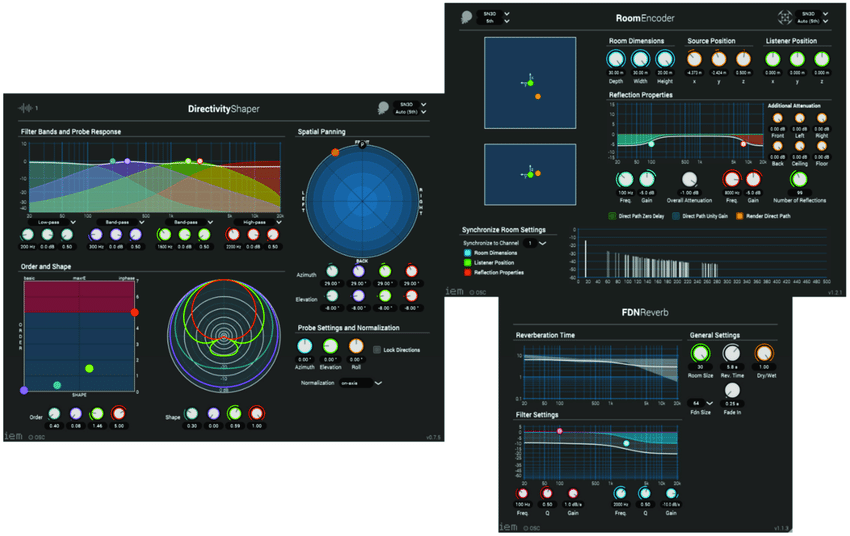
The IEM Plug-in Suite is a free and Open-Source audio plugin suite including Ambisonic plug-ins up to 7th order created by staff and students of the Institute of Electronic Music and Acoustics. The suite now comprises 21 plug-ins covering a full Ambisonic production chain, from encoders and reverbs to dynamics processors, including a limiter and a four-band multi-band compressor built to preserve spatial imaging, rotators, and decoders for both headphones and arbitrary loudspeaker layouts using the AllRAD approach. Its BinauralDecoder converts Ambisonic signals directly to binaural headphone audio using the MagLS method, based on HRTFs measured with a Neumann KU 100 dummy head, with optional headphone equalisation drawn from published measurements. Built with the JUCE framework and released under the GPLv3 licence, the plug-ins compile to all major formats, VST, VST3, LV2, AU and AAX, as well as standalone applications for JACK or virtual soundcards, and remain an ongoing, research-driven project that grows directly out of the institute's current research and student projects.

tech specs

technology:
binaural ambisonics
license:
free open source (GPLv3)
control:
osc
tool type:
plugin
last update:
14.02.2023

history

+

The IEM Plug-in Suite was developed at the Institute of Electronic Music and Acoustics at Graz's University of Music and Performing Arts, largely driven by Daniel Rudrich, who introduced the suite publicly in a dedicated workshop at the AES Convention in Milan in 2018. The plug-ins have grown steadily since their earliest releases, some, like the DualDelay, dating back to the very first version of the suite, receiving major overhauls over time, gaining DAW-sync, tap-delay and BPM-based timing, as well as new additions such as the GranularEncoder, the suite's first dedicated Ambisonic synthesiser plug-in. Support for Avid's AAX format arrived unexpectedly with version 1.15.0, extending the suite's reach into Pro Tools workflows, and it continues to be maintained and expanded today, now also hosted for ongoing development at TU Studio alongside its original IEM Graz home.

back to tools